Degrees, Debt and the Delivery Trap
 Abhijeet Singh
Women remain almost entirely excluded from the highest-volume segments. Two-wheeler delivery participation by women sits under 1% in urban India according to recent research.
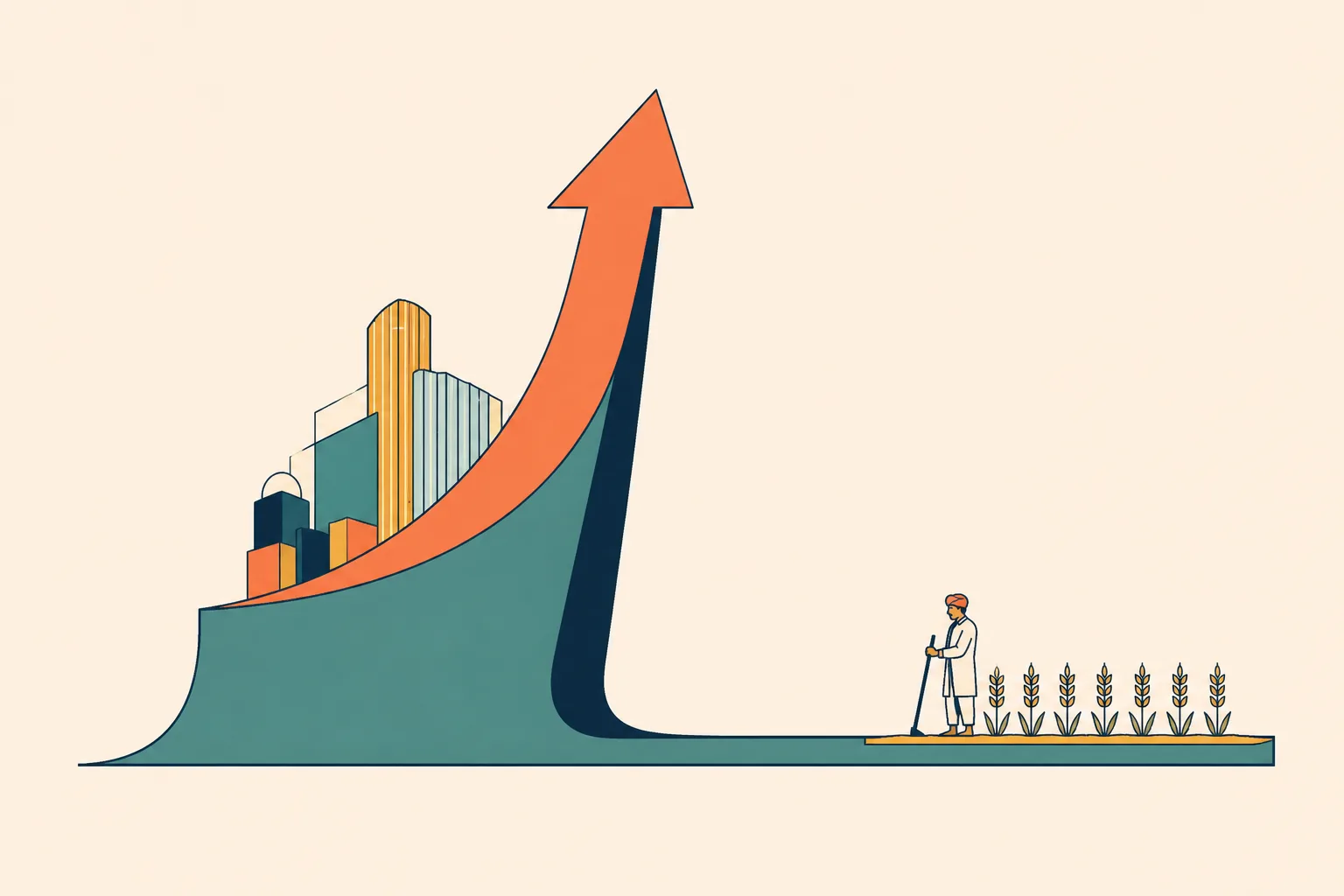
India’s platform workforce has grown from 7.7 million in FY21 to 12 million in FY25. Official projections put the figure at 23–23.5 million by 2029-30, or roughly 6.7% of the non-agricultural workforce. That expansion ranks among the largest employment shifts of the last decade, and it has occurred with almost no direct fiscal outlay by the state. The scale is real. The quality of the work, and the debt that often underwrites it, is the sharper question.
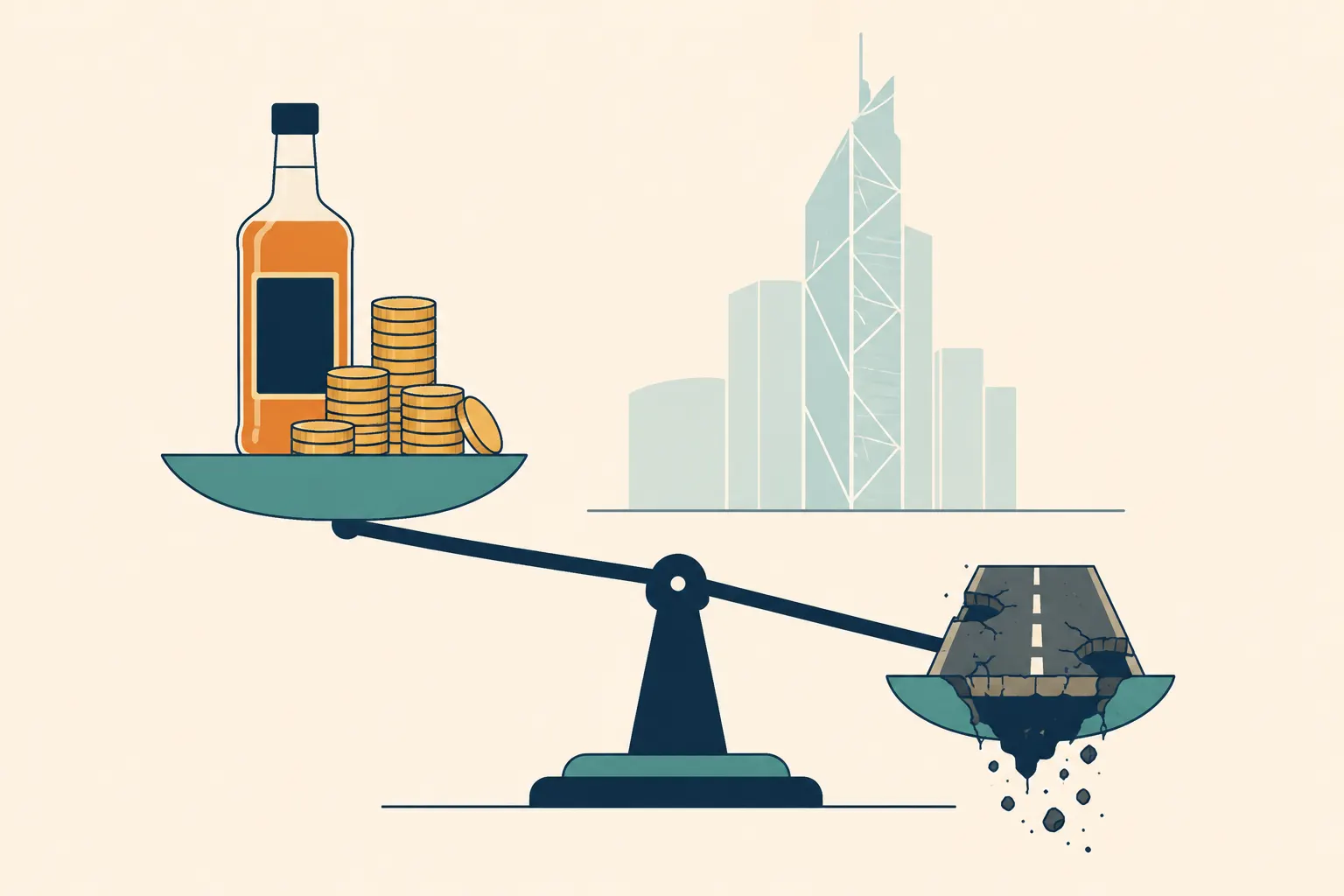
Government intentions are not difficult to understand. Create jobs that absorb young people, sustain urban consumption, and avoid the heavier cost of industrial subsidies or expanded rural guarantees. Public debt finances the roads, digital rails and power that make rapid delivery possible. India’s debt-to-GDP ratio remains lower than Japan’s (above 200%), the United States’ (near 125%), and several large European economies. Borrowing to build productive capacity can support growth. Borrowing that mainly underwrites the absorption of surplus labour into high-intensity, low-security work is a different calculation. The interest payments do not distinguish between the two.
The education system continues to produce graduates faster than the formal economy produces matching jobs. Unemployment among those with secondary education and above runs several times the overall rate. Graduate unemployment sits in the 11–13% range in recent data, far higher than the national figure near 3%. Among young graduates, only about 26 in 100 hold regular salaried positions; just 4 in 100 enjoy the full package of written contracts, paid leave and social security. Most employed graduates work outside their field of study. NITI Aayog analysis has put the share in high-competency occupations matching their qualifications as low as 8%. Families still treat the degree as insurance. The labour market treats it as optional. The waiting itself extracts a cost measured in depleted savings and lowered expectations.
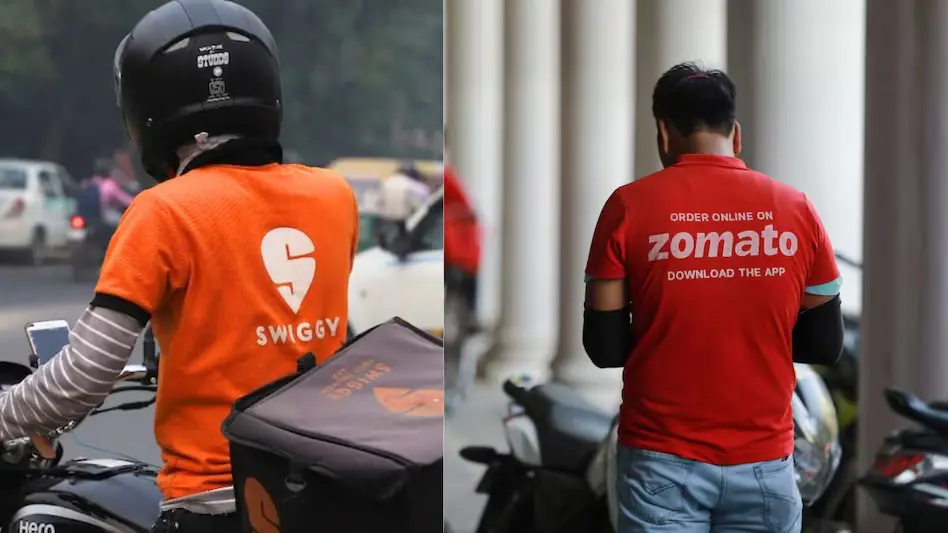
Platform work fills part of the resulting vacuum. It offers rapid entry and cash income for migrants and others with limited formal networks. Yet the arithmetic on the ground is unforgiving. Full-time metro earnings can reach the low-to-mid 20,000s rupees gross in strong months, but fuel, maintenance, data and penalties routinely claim 20% or more. Most partners do not log the full-time hours assumed in optimistic averages; platform data has shown average annual log-in days far lower. Earnings swing with weather, festivals, incentive changes and the constant arrival of new riders. Income volatility is not an exception. It is the baseline, as the Economic Survey has itself noted.
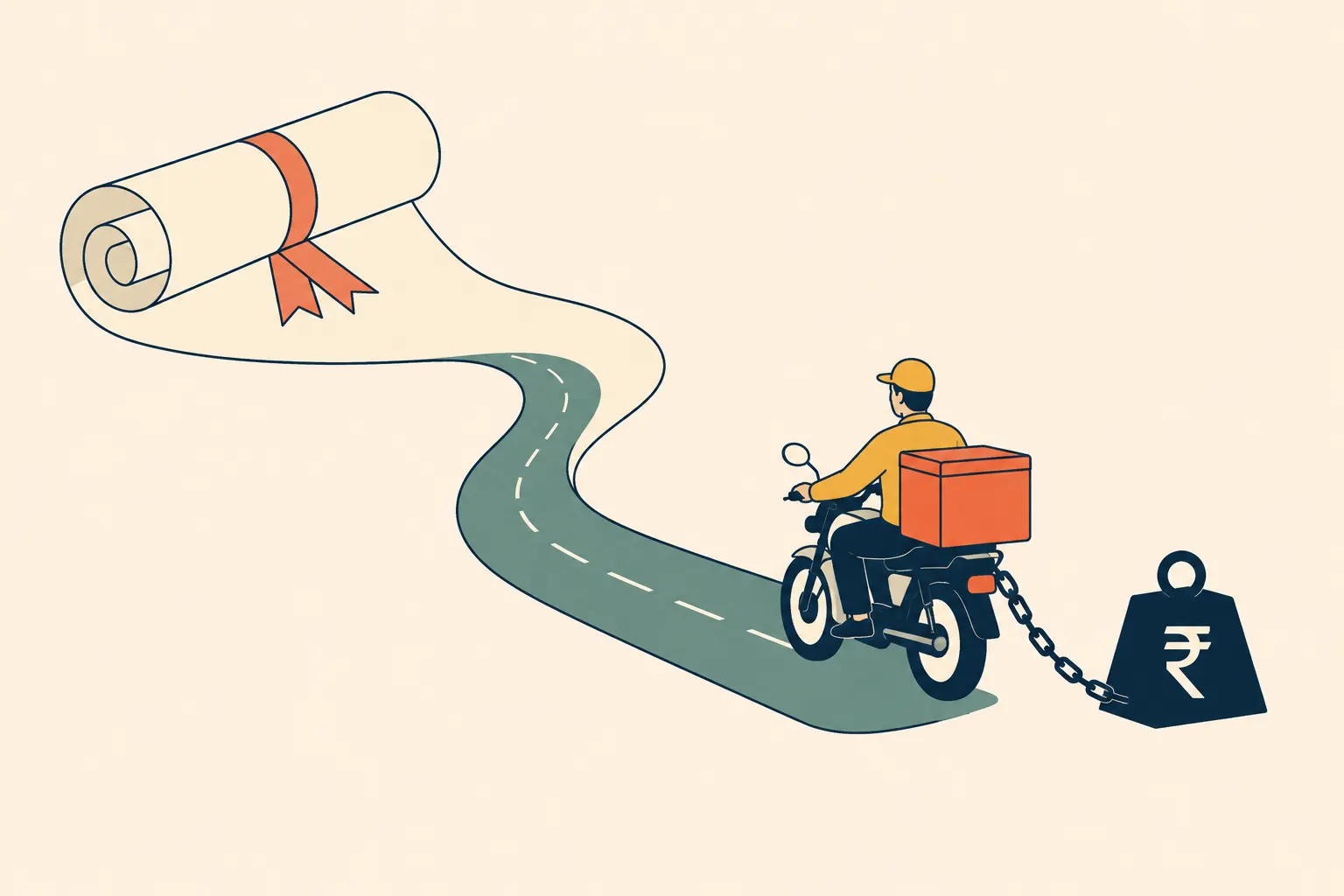
Debt converts that volatility into compulsion. A working two-wheeler is the practical entry ticket. Most riders do not purchase it with savings. Formal and semi-formal loans finance the bike and often the phone. Monthly EMIs of ₹2,500–4,000 become a fixed claim on irregular receipts. When volumes drop, the worker must simply ride longer to service the asset. Missed payments trigger penalties or recovery pressure. Fresh borrowing—frequently from fintechs at 14–36% or from informal sources—plugs the gap. Studies show 60% or more of gig workers struggle to access formal credit at reasonable rates because of thin credit files. The scooter becomes both the means of earning and the mechanism that makes exit expensive. This pattern is structural, not anecdotal.
Women remain almost entirely excluded from the highest-volume segments. Two-wheeler delivery participation by women sits under 1% in urban India according to recent research. Safety concerns, mobility restrictions, social norms and limited access to capital keep the numbers that low. The flexibility platforms advertise does not travel equally. Stakeholder economics therefore remains incomplete. Platforms control the algorithm, the incentive structure and the power to deactivate. Workers supply labour and their own capital, often debt-financed. The state supplies infrastructure and regulatory space. Consumers receive convenience priced on thin margins for the people doing the physical work. When terms tighten, the adjustment falls hardest on those already carrying vehicle debt and thin buffers.
Not every young person is suited to this work. It demands physical stamina, tolerance for heat and traffic, the ability to absorb unpaid waiting time, and a willingness to be rated by strangers after every trip. Many want something that compounds: skills that rise in value, relationships that open further doors, work that does not disappear with the next software update. Treating platform employment as a permanent destination for the non-elite is not a development strategy. It is a holding pattern that absorbs surplus labour while the formal sector expands too slowly.
Rhetoric from every side has been thin. Industry voices celebrate scale and disruption while soft-pedalling the human cost of algorithmic pressure, incomplete insurance and debt service. Activist critiques sometimes treat every platform job as pure exploitation without acknowledging that for many the realistic alternatives pay less or do not exist. Official statements highlight the jump from 7.7 million to 12 million and the path to 23 million while the design of portable social security, accident cover and income-smoothing tools still lags the speed of expansion. The facts sit in the middle. Platforms have absorbed millions at low fiscal cost. They have also concentrated risk—and vehicle debt—on workers who already operate with thin margins.
Debt-based growth only works when the assets raise future productivity. Degrees only retain value when the jobs that use them expand at scale. Gig work only serves as a bridge when credible exit routes exist. At present the bridges are crowded, the debt service is real, and the exits remain narrow. Young people who treat platform earnings as temporary income while they build skills that compound are navigating the system with clear eyes. Those who treat it as a destination risk being locked in when saturation, automation or the next incentive cut arrives.
The harder task is expanding the set of ordinary jobs that pay enough, protect enough and leave room for dignity. That requires looking squarely at the distribution of the 12 million current workers, the projected rise to 23 million, the real burden of vehicle EMIs, the near-total gender exclusion in delivery, the quantified mismatch between degrees and formal absorption, and the power imbalance between platforms and the people who keep the system moving. Until those numbers shape policy more than the rhetoric does, the gap between intention and ground will keep widening.