 Abhijeet Singh
Access to certain media, international platforms, and activist networks is easier when the critique aligns with a preferred political direction
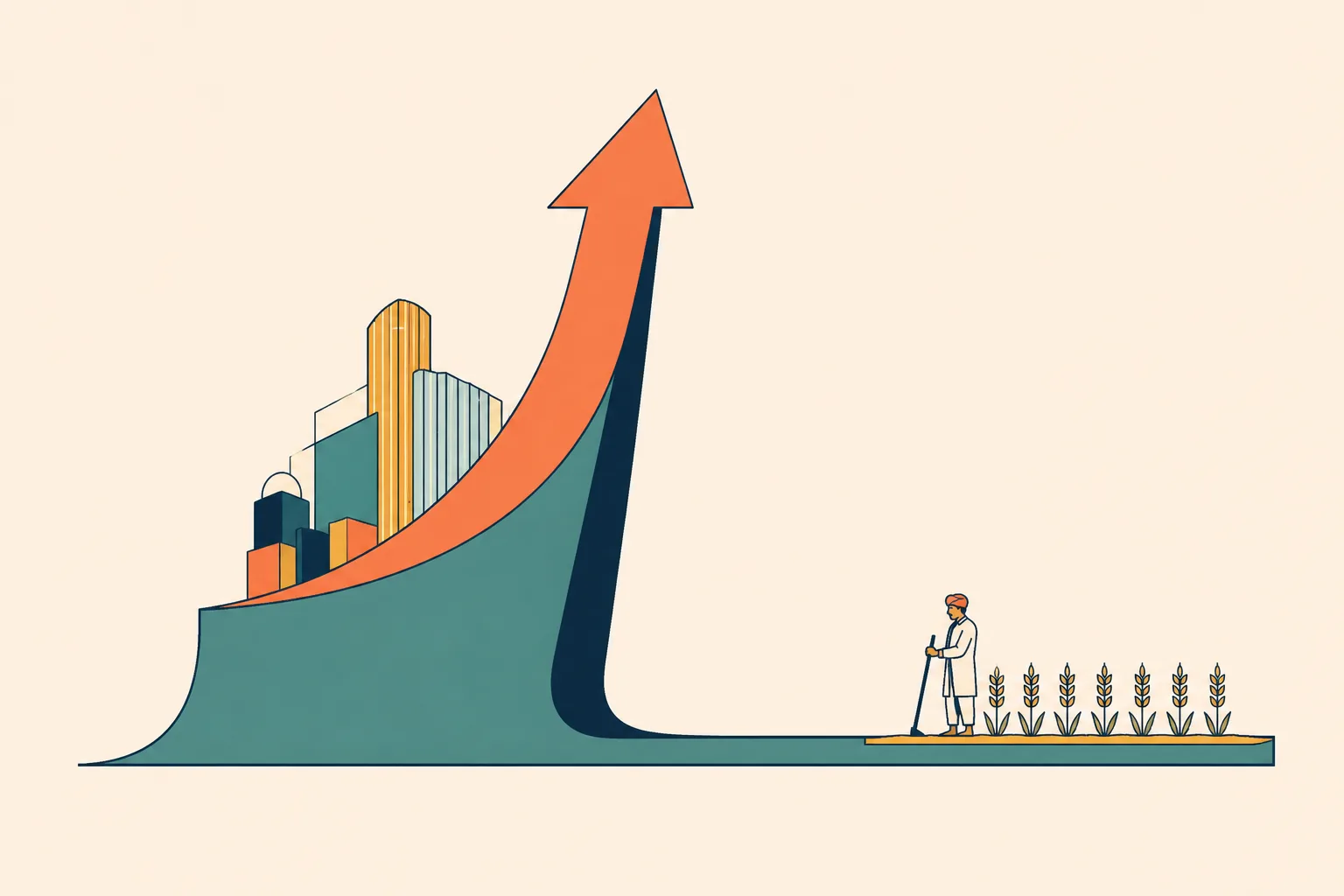
India’s economy grew 7.8 percent in real terms in the first quarter of FY 2026-27. Nominal growth stood at 10.3 percent. The Ministry of Statistics released these numbers after shifting to the 2022-23 base year. The same revision lowered the estimated size of the economy by roughly 3 to 3.8 percent across recent years. Former Finance Secretary Subhash Chandra Garg went on television and claimed that without the downward revision of the previous year’s Q1 figure from about ₹86 lakh crore to ₹80 lakh crore, nominal growth would have been only 2.6 percent. Several economists immediately pointed out that the ₹86 lakh crore number belonged to the old 2011-12 series while the current figure belonged to the new series. Comparing the two is not valid arithmetic. Yet the 2.6 percent claim travelled faster than the clarification.
| Indicator |
Official (New 2022-23 Series) |
Garg Claim (Old Series Mix) |
Difference |
| Real GDP Growth |
7.8% |
Near 0% (implied) |
7.8 percentage points |
| Nominal GDP Growth |
10.3% |
2.6% |
7.7 percentage points |
| Q1 FY26 Nominal GDP (base) |
₹80 lakh crore |
₹86 lakh crore (old series) |
₹6 lakh crore |
| Q1 FY27 Nominal GDP |
₹88.27 lakh crore |
Same |
— |
| Economy Size Revision (2022-26) |
3% to 3.8% lower |
Not adjusted |
Cumulative ₹43+ lakh crore |
This pattern is now familiar. A technical revision or a strong data release is followed within hours by a former official who extracts one number, strips the context, and offers a simpler, darker story. The story then becomes the headline for opposition parties and a section of the media. The actual series notes, the successive data updates, and the multi-year revision history remain unread by most viewers.
Look at the broader record. Between 2014 and 2024 the central government’s capital expenditure rose from under ₹2 lakh crore to more than ₹10 lakh crore in successive budgets. The ratio of capital spending to total expenditure climbed steadily. Road construction under Bharatmala and related programmes added tens of thousands of kilometres. Railway capital outlay crossed ₹2.5 lakh crore in recent years. Power generation capacity expanded by over 150 GW in the decade. These are not abstract claims. They appear in the budget documents and in the physical progress reports of the ministries.
| Scheme |
Beneficiaries / Units |
Key Metric |
Pre-2014 Baseline (approx) |
| Jan Dhan Yojana |
50+ crore accounts |
Bank accounts opened |
Under 15 crore |
| Ujjwala |
10+ crore connections |
LPG connections |
Under 2 crore |
| PM-KISAN |
11+ crore families |
Cash transfers (multiple instalments) |
Nil |
| PMAY (Housing) |
3+ crore houses |
Houses completed |
Under 50 lakh |
| Ayushman Bharat |
50+ crore individuals |
Hospitalisation cover |
Nil |
Welfare coverage expanded at the same time. Under the Pradhan Mantri Jan Dhan Yojana more than 50 crore bank accounts were opened. Direct benefit transfer systems now move subsidies for cooking gas, fertilisers, food and pensions without the earlier leakage rates of 30 to 40 percent reported in multiple CAG studies before 2014. The Ujjwala scheme distributed over 10 crore LPG connections. PM-KISAN has transferred cash to more than 11 crore farmer families in multiple instalments. The number of houses completed under PMAY crossed 3 crore. Ayushman Bharat covered over 50 crore individuals for hospitalisation costs. These numbers are large because the base population is large. They also represent a deliberate shift from price subsidies that leaked to targeted transfers that reach the intended household.
Public spending on these programmes rose even while the fiscal deficit was brought down from the double-digit levels seen after the pandemic. The same government that increased capital expenditure also raised the tax-to-GDP ratio through GST and better compliance. Corporate tax collections and personal income tax collections both showed double-digit growth in several years. The informal sector formalisation measured by GST registrations and e-way bills continued to expand.
| Year |
Approximate Signatories |
Main Subjects |
Recurring Names Present |
| 2017 |
65 (civil) + 114 (military) |
Cow vigilantism, intolerance |
Mander, Habibullah, Ribeiro |
| 2018 |
48–49 |
Kathua-Unnao, Bhima-Koregaon |
Roy, Mander, Saxena, Sircar |
| 2019 |
48–71 |
NRC-CAB, Pragya Thakur |
Saran, Ribeiro, Saxena |
| 2022 |
100+ |
Politics of hate |
Menon, Singh, Pillai, Jung, Nair |
| 2023 |
82–94 |
Civil service character, pension rules |
Agnihotri, Balachandran |
| 2026 |
93 |
Police action on students |
Menon, Lavasa, Dulat, Roy, Mander |
None of this has stopped a steady stream of post-retirement criticism from a small set of former officials. The Constitutional Conduct Group has issued open letters with 48, 65, 71, 82, 94, 100 and sometimes more signatories. The letters cover cow vigilantism in 2017, the Kathua and Unnao cases in 2018, Bhima-Koregaon arrests, the Citizenship Amendment Bill, Central Vista, politics of hate in 2022, changes to service rules in 2023, police action against student protesters in 2026, and several other subjects. The same names appear repeatedly: Anita Agnihotri, Aruna Roy, Harsh Mander, Julio Ribeiro, Wajahat Habibullah, Najeeb Jung, Shivshankar Menon, Sujatha Singh, Ashok Lavasa, A.S. Dulat, G.K. Pillai. Many of these officers held senior posts under previous governments. After retirement they discovered a consistent pattern of constitutional crisis under the current one.
Former Chief Economic Adviser Arvind Subramanian published papers in 2019 and again in 2026 arguing that GDP growth after 2011 was overestimated by 1.5 to 2.5 percentage points a year. The methodology relied on the divergence between official GDP and a set of physical indicators. The same author had been inside the system when the new series was introduced. The papers receive wide coverage each time they appear. Rebuttals that point to the limitations of the indicator set or the effect of structural formalisation receive less attention.
Retired military officers have joined on selected issues. Over 150 veterans, including several former service chiefs, wrote to the President in 2019 against the political use of the armed forces. Former Army Chief M.M. Naravane’s memoir excerpts described Agnipath as a scheme thrust upon the services. Former Navy Chief Arun Prakash called the scheme detrimental to combat effectiveness and described Agniveers as barely trained. A 2017 letter signed by more than 110 veterans condemned vigilantism and the targeting of minorities. These statements are real. They also represent a fraction of the total retired officer community.
Retired judges have spoken less often but with equal sharpness when they do. Justice Madan Lokur has criticised “bulldozer justice,” the use of UAPA and NSA, and the judicial backlog. Justice A.P. Shah has said the Supreme Court has watched the trampling of dissent. The 2018 press conference by four senior sitting judges remains a reference point. At the same time other groups of 21, 44, 56 and more retired judges have written letters defending the judiciary against what they call motivated political attacks. The retired judiciary is itself divided.
The cumulative effect of these interventions is measurable in public discourse. Every GDP release is now preceded by the expectation of a counter-claim. Every welfare announcement is followed by a letter questioning motives or implementation. The volume of open letters creates an impression of continuous institutional revolt. The common citizen who receives the DBT credit, the LPG connection, or the completed house does not write open letters. The citizen who travels on the new highway or the expanded metro does not appear on television panels. The noise is generated by a few hundred people who once held high office and who retain access to platforms.
This noise has costs. Policy uncertainty rises when every major data release is immediately contested by a former insider. Investor confidence is affected when growth numbers are treated as inherently suspect. Administrative officers still in service observe the post-retirement trajectory of their seniors and adjust their own risk appetite. Constructive criticism that identifies specific implementation failures or data gaps is drowned by the broader claim that the system itself is compromised. The distinction between a technical disagreement over deflators and a charge of statistical jugglery collapses.
The intellectual dishonesty is selective. Many of the same voices were silent or supportive when similar methodological revisions or welfare expansions occurred under earlier governments. The 2011-12 base year change itself produced large upward revisions in the size of the economy. The silence then and the volume now is not explained by a sudden discovery of statistical principle. It is explained by the identity of the government in power. Stakeholder economics plays its part. Access to certain media, international platforms, and activist networks is easier when the critique aligns with a preferred political direction.
The common citizen experiences the results differently. A farmer who receives the PM-KISAN instalment every four months does not recalculate the GDP deflator. A woman who no longer has to collect firewood because of an Ujjwala connection does not debate the informal sector proxy. A student whose school received a new classroom under a central scheme does not parse open letters about institutional hatred. These citizens form the electoral majority that has returned the government three times. Their lived experience of improved connectivity, direct transfers, and expanded basic services sits in tension with the narrative produced by the retired elite.
Constructive criticism remains necessary. Data quality in India has genuine gaps. Informal sector measurement is imperfect. Deflator choices affect real growth estimates. Implementation of welfare schemes has leakages and exclusion errors. Agnipath required better consultation and longer training. Capital expenditure must eventually translate into private investment. These are legitimate subjects for debate. A former finance secretary who points to a specific series inconsistency and explains the arithmetic can improve public understanding. A former CEA who publishes a transparent paper with clear assumptions contributes to the technical literature. A retired general who argues that short-term recruitment reduces unit cohesion forces the system to respond with better data on retention and training outcomes.
| Individual |
Former Position |
Key Public Claim / Action |
Year(s) |
| Subhash Chandra Garg |
Finance Secretary |
Q1 growth effectively 2.6% due to revision; books on internal differences |
2019–2026 |
| Arvind Subramanian |
Chief Economic Adviser |
GDP overestimated 1.5–2.5 pp annually post-2011 |
2019, 2026 |
| Madan B. Lokur |
Supreme Court Judge |
“Bulldozer justice”, UAPA/NSA overuse, backlog |
2023 onward |
| A.P. Shah |
Delhi/Madras HC Chief Justice |
Judiciary watched trampling of dissent |
Post-2014 interviews |
| M.M. Naravane |
Army Chief |
Agnipath “thrust upon” services |
Memoir excerpts |
| Arun Prakash |
Navy Chief |
Agnipath degrades combat effectiveness |
2022–2024 |
| Multiple veterans |
Service Chiefs & officers |
150+ signatories against political use of military |
2019 |
The problem begins when the same individuals move from technical disagreement to a continuous claim of systemic malice. When every revision is treated as fudging, every welfare expansion as electoral bribery, and every security decision as authoritarian overreach, the space for evidence-based correction shrinks. Public opinion is shaped by the loudest and most repeated claims rather than by the cumulative physical evidence of roads built, accounts opened, and transfers completed. The nation pays the price in delayed consensus on reforms that require broad support.
Only a small number of powerful people after retirement choose this path of sustained institutional attack. The majority of retired civil servants, judges and officers remain silent or continue private work. The few who dominate the public conversation create the impression of a larger revolt than exists. Their access to platforms multiplies the effect. The result is a distorted feedback loop in which the government is forced to spend political capital defending numbers that the underlying data already support, while genuine implementation problems receive less focused attention.
India’s growth rate of 7.8 percent in a single quarter does not solve every problem of employment quality or regional disparity. The rise in capital expenditure does not automatically produce matching private investment. The expansion of welfare coverage does not eliminate exclusion. These are real limits. They are also different from the claim that the growth itself is fabricated or that the welfare architecture is primarily an instrument of political control. The numbers on bank accounts, LPG connections, highway kilometres, and tax collections are large, verifiable, and cumulative. They continue to expand even as the open letters continue to arrive.
The test for any post-retirement intervention is simple. Does it improve the accuracy of public understanding or does it substitute one selective narrative for another? The record of the last decade shows that a minority of former officials have chosen the second route with consistency. The cost is paid by the clarity of public debate and by the ability of the system to correct itself on the basis of evidence rather than on the basis of prior institutional loyalty.